

The Philosophy of xCue
A great escape room is remembered for its atmosphere, its rhythm and the way it guides the player through the story. The escape room puzzles matter, the effects matter, the lights, the sound, the transitions between stages and the overall feeling of the game from the very entrance to the final moment.
That is the point of view from which xCue was built. We needed software that helps manage not just the room's logic, but the immersion itself. When we were building our own games, it was important to us that the system supported the atmosphere throughout the entire player journey: from the pre-entry experience we call intro mode, all the way to the final exit with music playing. xCue is designed as a tool that helps you shape a scenario into a complete story with the right pace and feeling.
xCue brings together the scenario, room devices, light, sound, video, mechanics and the operator interface into one system.
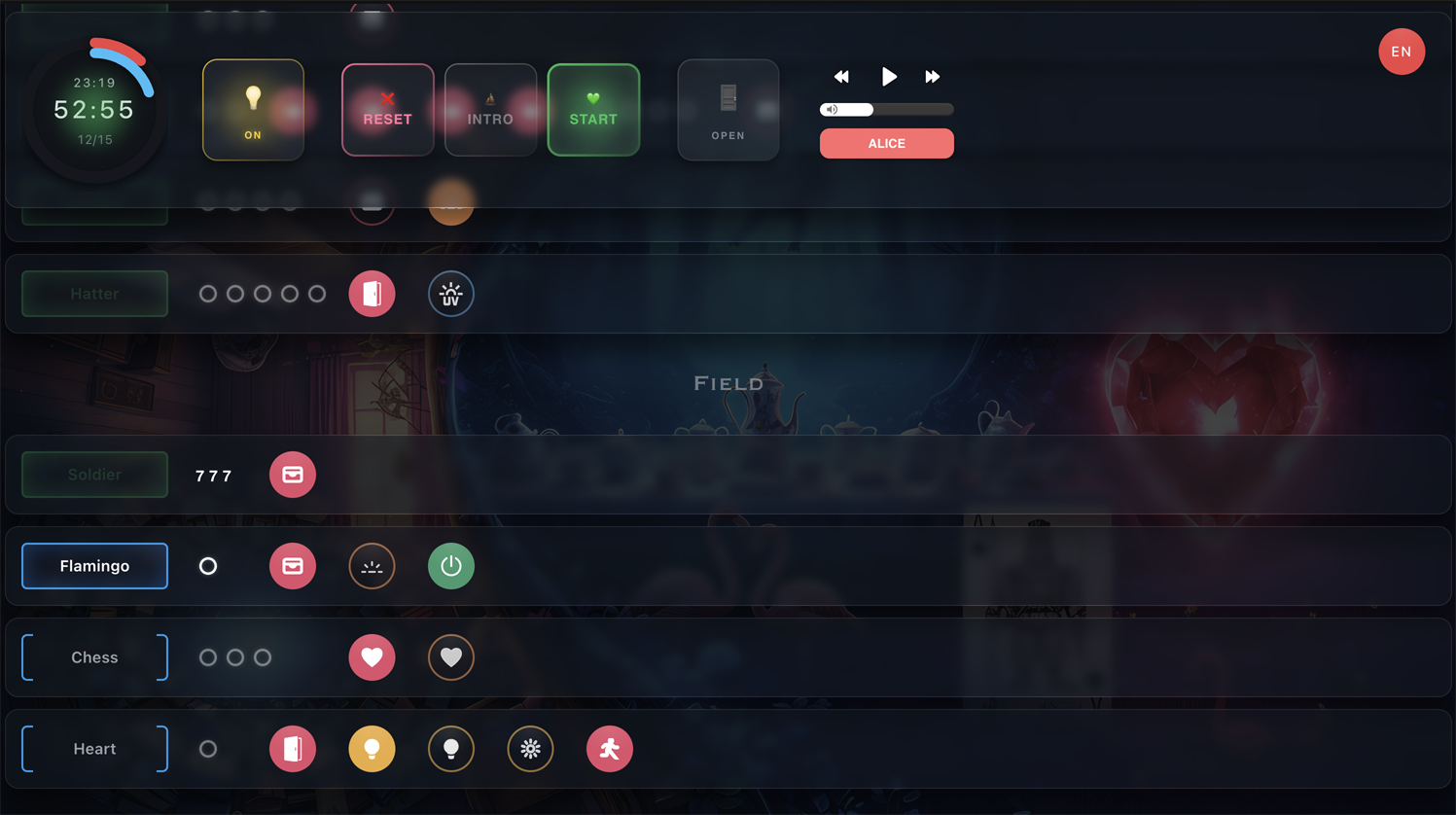
During a game, xCue responds to incoming signals from buttons, RFID sensors, screens and other game nodes, then triggers the right actions according to the scenario. That can mean changing the lighting, playing a sound or video, activating a mechanical element, triggering effects, moving to the next stage or executing a manual command from the operator.
For the operator it looks simple and clear. The entire scenario is laid out on screen by puzzle, stage and room, following the same logic as the game itself. They see the state of key nodes, see what actions players are taking, what signals are coming into the system, whether a puzzle is being solved correctly and exactly where in the game the team is right now. Everything is displayed in a way that is intuitive and visually readable, so that during a session there is no need to dig into technical details.

We build the interface around the specific room. What matters for the operator is not hunting through folders and lists for the right function, but immediately seeing what is actually important in the moment: the active stage, device status, quick actions, hints and manual controls. This approach significantly reduces the load on the operator. The system handles automatic responses and allows one person to calmly run two games at the same time without constant tension or fear of missing something or triggering it at the wrong moment.

The scenario system in xCue allows you to build both simple sequential chains and more complex rooms with parallel events, conditions, timings, branching and dependencies between nodes. Some parameters can be moved into settings so they can be changed without reprogramming.

Sound and media have always been especially important to us. xCue works with multiple independent audio outputs and can simultaneously trigger video and other media content on projectors, TVs and screens inside the room. This makes it possible to precisely control the atmosphere of the game and connect voice, music, ambient sound, video clips, hints and scenario events into a single coherent experience.
When the operator speaks into a microphone or a voice hint is triggered, the system can automatically lower the background audio so the speech comes through cleanly. Different language versions of audio and media can be loaded and switched as needed.
The same logic applies to lighting, effects and show elements. The scenario can control lighting, addressable LED strips, DMX scenes, fog machines and other effects so that the atmosphere shifts together with the game logic and amplifies the right moment.

On the technical side, xCue was built to be a system that is easy to understand and easy to maintain. We went through a long journey ourselves: from Arduino, homemade solutions, toggle switches, relays and manual control to a fully centralized system. That experience gave us a very practical understanding of what actually works in a real room, what overloads the operator, what breaks down in daily use and what helps a system stay stable every single day.
xCue is not tied to one specific set of hardware. You can connect different types of sensors, controllers, mechanical devices, screens, interactive stations, lighting systems and audio equipment. This gives you freedom when designing a room and lets you build game solutions around the task, not around the platform's limitations.


